
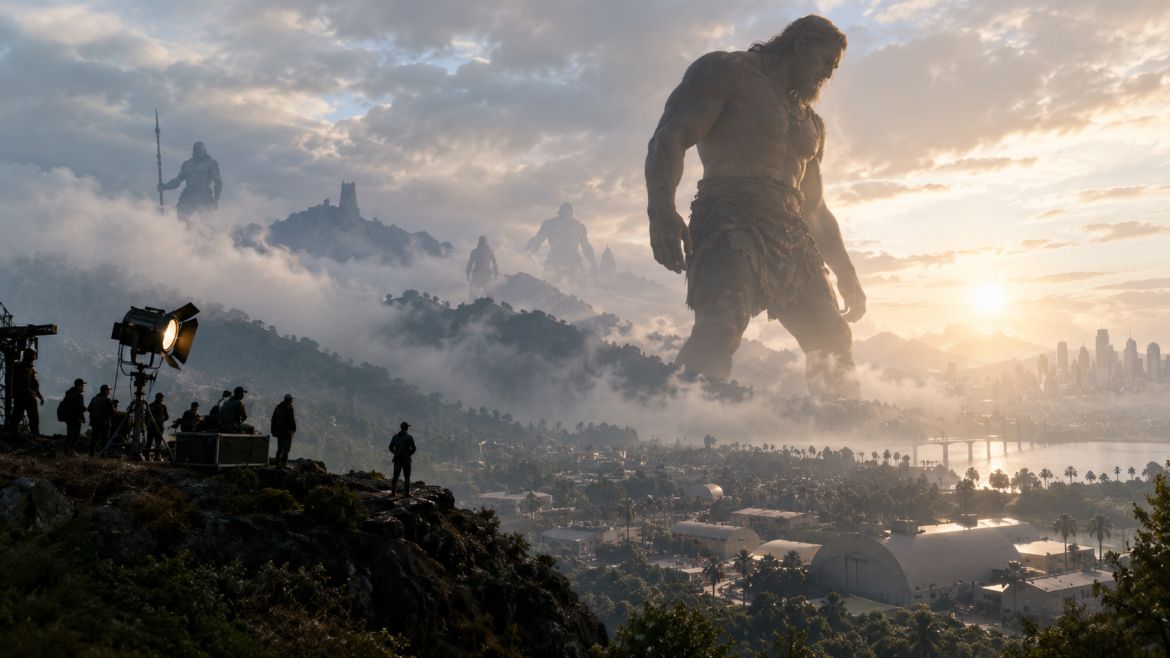
From legendary beasts to titanic heroes, cinema has continually explored the theme of size, leaving audiences in awe of massive creatures and characters. Among these colossal figures, some have become unforgettable icons in film history. Steven Spielberg’s 2016 adaptation of Roald Dahl’s “The BFG” brought the Big Friendly Giant to life with Mark Rylance playing the 24-foot character through motion-capture technology. This tale of an orphan named Sophie, taken into a realm of giants, offers a visually polished experience, though some believe it lacks the tangible magic of Dahl’s original narrative. Similarly, the 2013 film “Jack the Giant Slayer” features Nicholas Hoult as a farmhand embroiled in a war between humans and giants, blending fairy tale charm with grandiose fantasy, highlighted by Ewan McGregor’s near-culinary fate at the hands of a giant.
Peter Jackson’s 2012 “The Hobbit: An Unexpected Journey” briefly transports its audience to a spectacular skirmish featuring stone giants, capturing the ancient menace of Middle-earth’s titans. Meanwhile, the 2005 film “Harry Potter and the Goblet of Fire” introduces Madame Maxime, a towering figure who shares a tender connection with Robbie Coltrane’s half-giant, Hagrid. These films illustrate how giants have been used to enhance narratives with grandeur and emotion. In contrast, the 1957 sci-fi classic “The Amazing Colossal Man” and the 1958 B-movie “Attack of the 50ft Woman” demonstrate how the theme of gigantism has been used to explore human vulnerabilities and societal fears, with their protagonists undergoing extraordinary transformations with destructive consequences.
Historical adventures like the 1954 “Ulysses” and the animated 1939 “Gulliver’s Travels” have also immortalized giants in cinema. Kirk Douglas’s Ulysses faces the Cyclops Polyphemus, a consequence of his crew’s greedy raid, while Gulliver finds himself among the miniature people of Lilliput. André Øvredal’s 2010 “Troll Hunter” delves into Scandinavian folklore, uncovering the hidden existence of trolls, including a massive Jötunn. In Tim Burton’s 2003 “Big Fish,” Matthew McGrory plays Karl the Giant, a character woven into Edward Bloom’s fantastical tales, adding a grounded yet mythical touch to the narrative.
Animated films like 2009’s “Monsters vs Aliens” and 1999’s “The Iron Giant” have used the concept of giants to blend humor and heart with larger-than-life tales. Reese Witherspoon voices a bride turned giantess in a nod to 1950s sci-fi, while Brad Bird’s “The Iron Giant” tells a poignant story of friendship and sacrifice amidst Cold War tensions. Giants also play pivotal roles in recent films such as the 2022 “Three Thousand Years of Longing,” where Idris Elba’s djinn shifts size, and David Lowery’s 2021 “The Green Knight,” which features mysterious, silent giants that enhance the film’s mythical atmosphere.
Classics like the 1940 “The Thief of Bagdad” and 1987’s “The Princess Bride” continue to be celebrated for their portrayal of giants. The former features a formidable genie brought to life with groundbreaking effects, while the latter sees André the Giant endear audiences with his natural charm as Fezzik. Topping the list is the 1963 “Jason and the Argonauts,” where Ray Harryhausen’s Talos, a bronze titan, showcases the power of stop-motion animation. The sequence where Talos awakens, set to Bernard Herrmann’s score, remains a landmark moment, blending fantasy with cinematic craftsmanship to create a giant that is both imposing and tragically noble.