
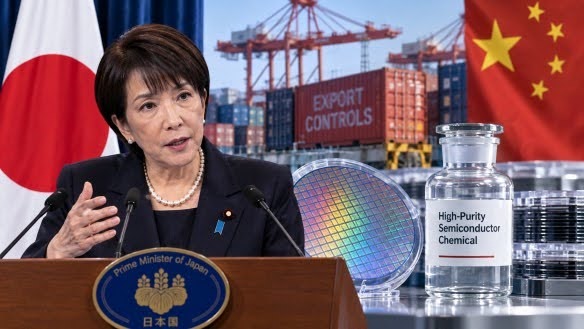
China’s recent decision to enforce stringent export restrictions on dichlorosilane (DCS), a crucial chemical in semiconductor production, has prompted a formal protest from Japan. The Japanese government is closely examining how these measures might impact its companies, such as Shin-Etsu Chemical and Denal Silane, which are among the leading exporters affected by the new rule. Under the new restrictions, Chinese importers of DCS from Japan are now required to make cash deposits of up to 99.2%.
The restrictions, described by China as provisional, were implemented following an anti-dumping investigation that concluded Japanese DCS exports had adversely affected China’s domestic market. While these measures are temporarily in place, a final decision will be made once the investigation reaches its conclusion. In response, Japan’s government has called on China to ensure that these restrictions do not unjustly harm Japanese businesses, stating that it is prepared to take necessary actions to protect its interests.
The introduction of these export restrictions occurs against the backdrop of strained relations between China and Japan, exacerbated by Japan’s stance on Taiwan. Tensions between the two nations have also been fueled by China’s imposition of various trade and export controls targeting Japanese companies, particularly those involving products with dual-use capabilities that could potentially serve military purposes.
Dichlorosilane plays a pivotal role in semiconductor manufacturing, where it is utilized to form ultra-thin silicon layers on computer chips. Japan is a leading global producer of ultrapure DCS, which underscores the significance of these new export restrictions on the global semiconductor supply chain. As the situation develops, stakeholders in the semiconductor industry are closely monitoring the potential ramifications of these trade measures on the market.