
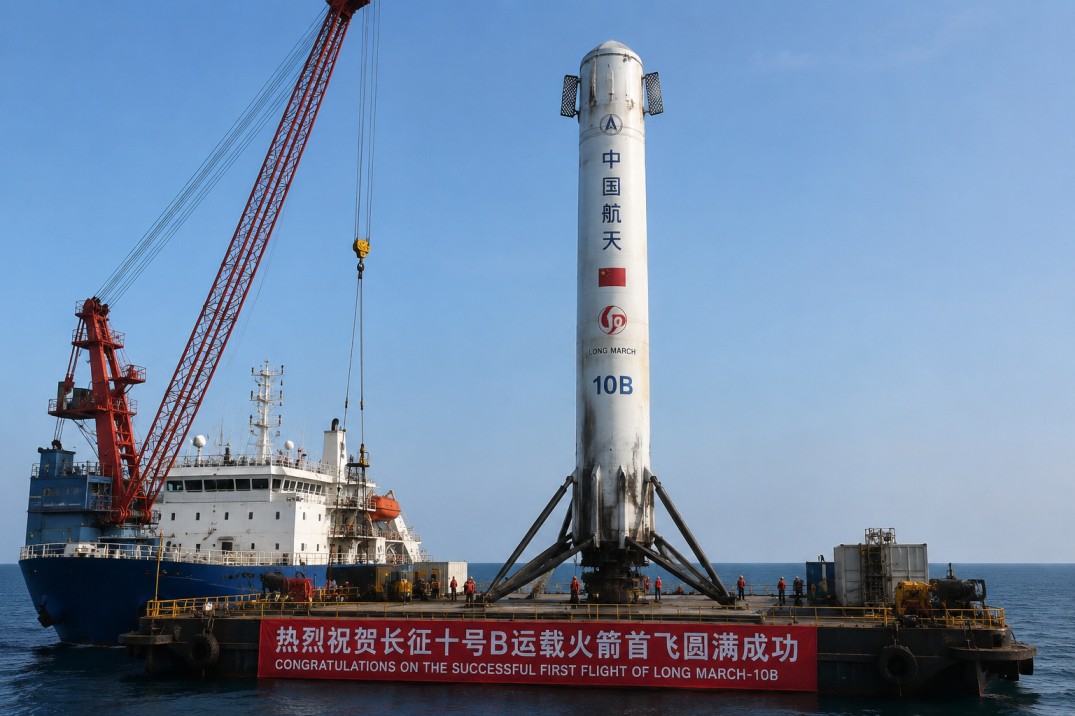
China has achieved a significant breakthrough in its space exploration efforts by successfully recovering the Long March 10B rocket after completing its inaugural orbital mission. This accomplishment positions China as the second country, following the United States, to prove the reliability of reusable orbital rocket technology. The mission underscores the nation’s determination to advance its capabilities in space launch systems.
The towering 63.6-meter Long March 10B rocket launched from the Hainan International Commercial Aerospace Launch Center. It was propelled by seven engines utilizing a combination of liquid oxygen and kerosene. After the initial stage separation, the rocket’s second stage continued the mission powered by a liquid oxygen-methane engine, which efficiently delivered a satellite into its intended orbit. This mission highlights China’s growing expertise in complex space operations.
One remarkable aspect of this mission was the successful recovery of the orbital-class rocket, marking the first time a wire arrestment recovery system has been used to achieve such a feat. This innovative approach to retrieving rockets represents a major advancement in reusable launch technology, a field that is becoming increasingly important as space agencies strive to reduce costs and improve efficiency in space travel.
China’s space program has been expanding rapidly, with this latest achievement adding to its list of milestones. By demonstrating the capability to recover and reuse rockets, China is setting the stage for more frequent and cost-effective space missions in the future. This technological leap not only benefits China’s ambitions in space but also contributes to the global movement towards more sustainable and economically viable space exploration.