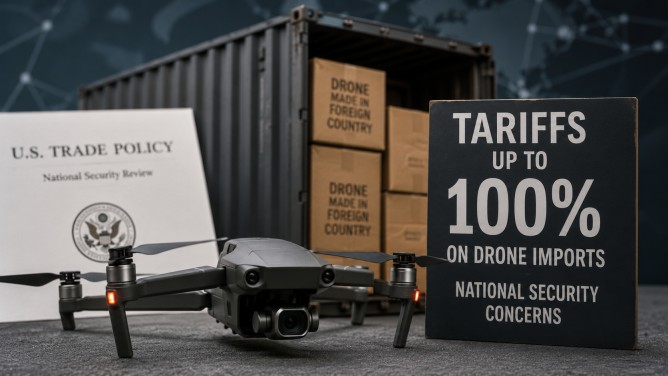
In a move aimed at addressing national security concerns and reducing reliance on Chinese supply chains, the United States has unveiled tariffs as high as 100% on certain drone imports and components. The policy places particular emphasis on unmanned aircraft systems, especially those weighing over 25 kilograms and equipped with features like thermal cameras and docking stations that are linked to national security. These specific products will incur the highest tariff rate of 100%, while smaller drones will be subjected to a 25% tariff.
The sweeping tariffs also extend to drone imports and parts from several significant trading partners, including the European Union, Japan, Liechtenstein, South Korea, Switzerland, and Taiwan, which will face a 15% tariff. Meanwhile, imports from the United Kingdom will see a 10% tariff, provided the technology originates from these countries or the US. This comprehensive tariff strategy is set to be implemented starting September 3.
The White House has articulated that these new measures are designed to bolster the US defense and industrial base, promote domestic drone manufacturing, and generate jobs within the country. By imposing these tariffs, the US aims to decrease its dependency on foreign suppliers. China, currently a dominant force in the global drone market, with Shenzhen-based DJI capturing a substantial portion of the US commercial drone sector, has been a particular focal point of US restrictions due to ongoing national security debates.
US authorities have raised concerns that drones manufactured abroad could pose significant risks, including unauthorized surveillance, sensitive data gathering, and possible acts of aggression. The Federal Communications Commission has echoed the call for increased domestic production as a means to mitigate these risks.
This development unfolds amidst ongoing trade and technology disputes between Washington and Beijing. In a reciprocal manner, China has imposed its own export limitations on drones to the US and has targeted several American companies with restrictions. The unfolding tension highlights the intricate and competitive nature of the global technology supply chain, with drones being a critical point of contention between the two economic powerhouses.