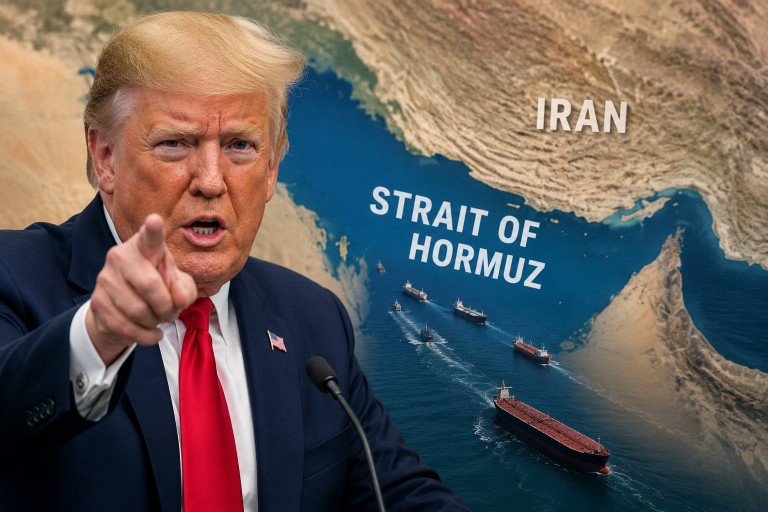
In a bold statement, US President Donald Trump has suggested that the United States might soon declare the Strait of Hormuz as its territory, amidst ongoing tensions with Iran. Speaking in New York, Trump indicated that such a declaration could follow the defeat of Iran, asserting that the US already exercises control over the vital maritime passage through a blockade. This strait is a crucial conduit for global oil transportation, with about 20% of the world’s seaborne oil passing through its waters. The waterway, nestled between Iran and Oman, has faced significant restrictions since military operations by the US and Israel commenced against Iran.
It remains uncertain if Trump’s remarks signal an actual shift in US foreign policy or if they were intended as a strategic political maneuver. Iran has swiftly dismissed the notion, with Deputy Foreign Minister Kazem Gharibabadi emphasizing that Tehran will not cower under US pressure, asserting that decisions about the strait’s operation lie within Iran’s jurisdiction. Iranian Foreign Minister Abbas Araqchi further clarified that Tehran has yet to agree to resume formal negotiations with Washington, despite ongoing message exchanges facilitated by Qatar and Pakistan.
Iran has stipulated several conditions for reopening the strait to international shipping, which include demands for compensation for war-related damages, the lifting of economic sanctions, and the unfreezing of Iranian assets. The persistent conflict and resultant disruption to shipping routes have contributed to rising fuel prices, placing additional financial strain on consumers worldwide. President Trump has justified the increased costs, arguing that the higher fuel prices are a necessary measure to prevent Iran from developing nuclear weapons.
The impasse over the Strait of Hormuz has sparked considerable concern regarding global energy supplies and the broader economic repercussions. As both nations continue to hold firm on their positions, the international community watches closely, wary of the potential for escalating tensions to further destabilize the region and impact worldwide markets.