
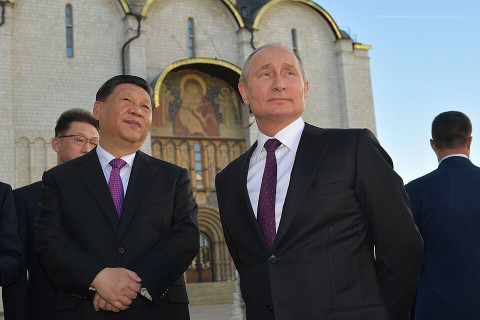
In anticipation of Vladimir Putin’s upcoming visit to Beijing, Chinese President Xi Jinping and the Russian leader exchanged “congratulatory letters” on Sunday. This visit, which follows closely on the heels of Donald Trump’s departure from China, highlights the strengthening ties between Russia and China. According to Chinese state media, Xi emphasized that their bilateral cooperation has “continuously deepened and solidified,” as the two nations celebrate the 30th anniversary of their strategic partnership this year. The Kremlin’s aide, Yuri Ushakov, confirmed that Putin would arrive in China on Tuesday evening and meet Xi on Wednesday morning to discuss various aspects of their bilateral relationship, including the proposed Power of Siberia 2 gas pipeline.
The convergence of visits from both the US and Russian leaders in such a short time span has drawn significant global attention. Analysts have noted the rarity of a nation hosting leaders from both countries consecutively within a week in the post-Cold War era. China’s growing relationship with Russia has sparked concerns in the West, especially after Russia’s full-scale invasion of Ukraine in 2022. Western diplomats and analysts argue that China’s economic and diplomatic support for Russia has played a role in prolonging the conflict. Xi and Putin have met over 40 times, surpassing Xi’s interactions with Western leaders, and trade between China and Russia has reached unprecedented levels since 2022.
China’s import of more than a quarter of Russia’s exports, including significant amounts of crude oil, has provided Russia with substantial revenue amid the ongoing war in Ukraine. Data from the Centre for Research on Energy and Clean Air indicates that Beijing has purchased over $367 billion worth of Russian fossil fuels since the conflict began. These acquisitions have bolstered China’s energy security, a priority heightened by disruptions in oil shipments through the Strait of Hormuz due to the Middle East crisis.
During Trump’s recent visit to China, discussions seemed to center on trade, Taiwan, and Middle Eastern conflicts rather than the war in Ukraine or Sino-Russian relations. A brief mention of the “Ukraine crisis” was made in the Chinese statement about the bilateral meeting, while it was absent from the US statement. Trump reported that China agreed on the need to reopen the Strait of Hormuz. Additionally, Xi cautioned Trump on the potential for conflict over Taiwan, as Trump deliberated on a significant arms deal with the island, a move that Beijing opposes.
Joseph Webster, a senior fellow at the Atlantic Council, suggested that Taiwan might be an underlying theme in the Xi-Putin discussions. Webster speculated that China could be aiming to secure more fossil fuel agreements with Russia to ensure a steady energy supply in case of future conflicts over Taiwan. The expansion of Russian oil pipeline capacity to China could significantly enhance Beijing’s oil security in such scenarios. Meanwhile, Russia continues to advocate for the progression of the Power of Siberia 2 gas pipeline, which would increase the capacity between the two countries by 50 billion cubic meters.