
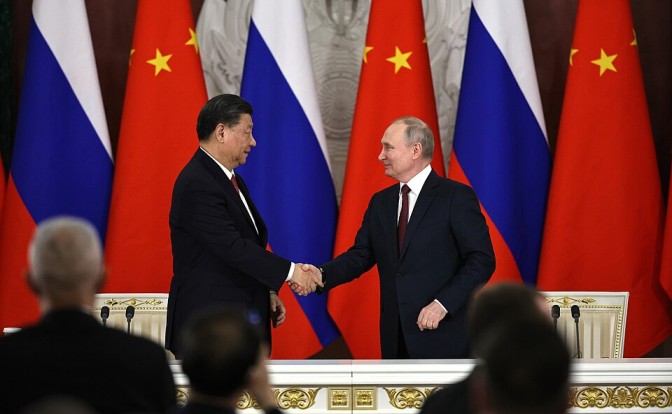
During a meeting in Beijing, President Xi Jinping and Russian President Vladimir Putin committed to extending the China-Russia Treaty of Good-Neighborliness and Friendly Cooperation. The leaders pledged to enhance their countries’ political trust, strategic coordination, and practical cooperation in response to an unpredictable international environment. The agreement was finalized at the Great Hall of the People before Putin ended his two-day state visit to China.
After their discussions, Xi and Putin signed a joint statement to bolster their comprehensive strategic coordination and deepen friendly cooperation. They also oversaw the signing of 20 agreements in sectors such as economy, trade, education, and science and technology. A joint statement advocating for a multipolar world and new international relations was also issued. Xi highlighted that this visit marks Putin’s 25th trip to China since 2000, underscoring the unique nature and high level of China-Russia relations.
This year marks significant anniversaries for both nations, celebrating 30 years of strategic partnership and 25 years since the signing of the treaty. The treaty, last extended in 2021, is based on principles of non-alliance, nonconfrontation, and not targeting third parties, focusing on equality and mutual respect. Xi emphasized the importance of building on past achievements, advocating for strengthened strategic communication, and expanding the foundation of political trust between the two countries.
Xi also addressed global governance, noting the challenges posed by unilateralism and the threat of returning to the “law of the jungle.” As permanent members of the United Nations Security Council, China and Russia should uphold the UN’s authority and oppose unilateral acts that reverse historical outcomes. Putin echoed this sentiment, expressing confidence in the future of bilateral relations and emphasizing the self-sufficiency of their partnership. He stressed the need for cooperation within international frameworks like the Shanghai Cooperation Organization and BRICS.
Further developments included the extension of visa-free policies between the two countries until 2027 and discussions on international and regional issues, such as the Middle East conflict. Xi called for an immediate cessation of hostilities in the region, highlighting the impact on energy stability and global trade. The day concluded with a welcoming banquet for Putin at the Great Hall of the People, symbolizing the continued commitment to deepening China-Russia ties.